
Play Yukon Solitaire Online for Free
Yukon Solitaire is a close relative of Klondike Solitaire with no stockpile. All 52 cards are dealt to the tableau at the start, and you can move any face-up card along with every card on top of it, even when those cards aren’t in order. That freedom turns each deal into a puzzle of digging out the face-down cards and building the foundations from Ace to King.
Yukon Solitaire Objective
Win Yukon Solitaire by moving all 52 cards to the four foundations, building each one up in suit from Ace to King.
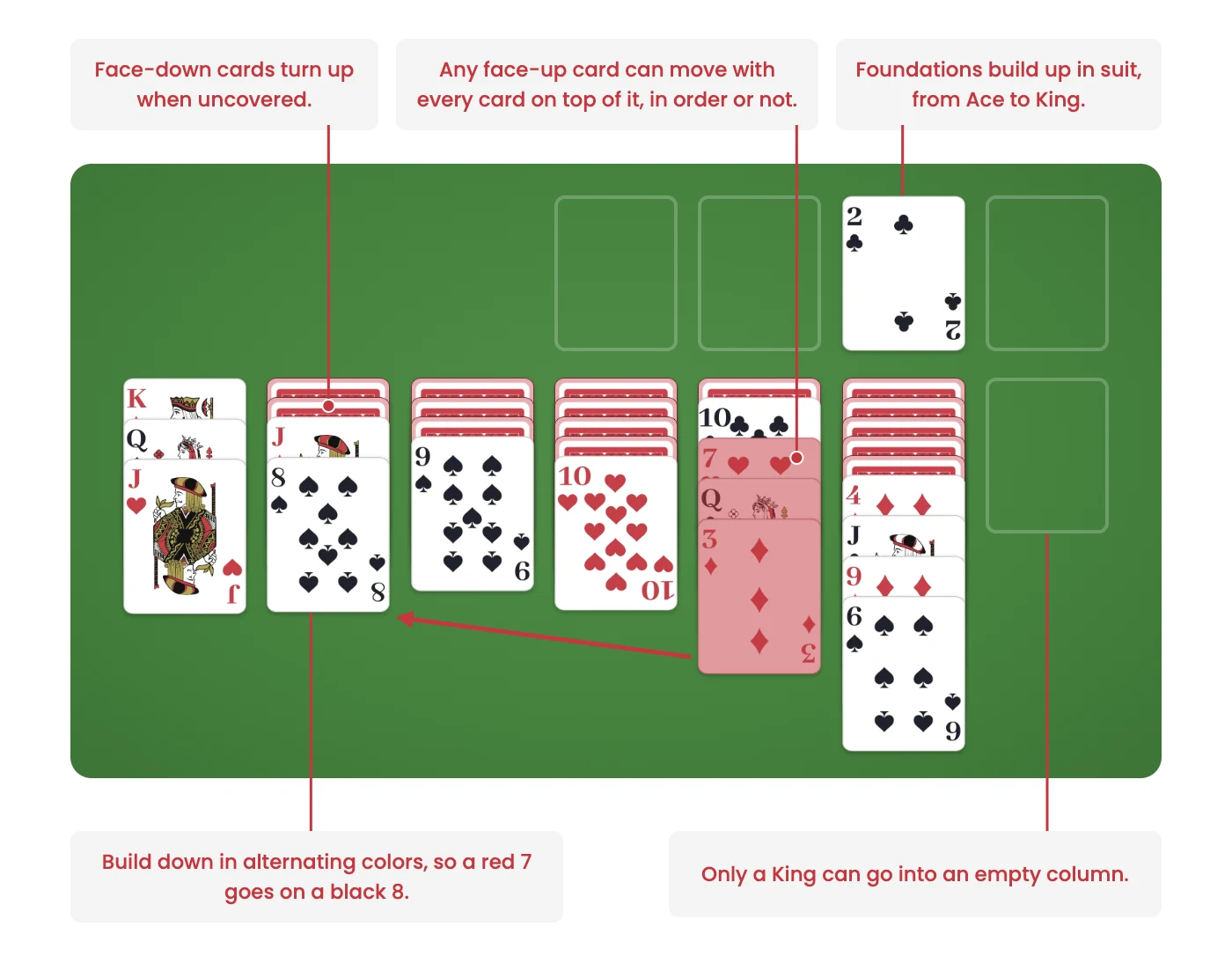
The whole deck is dealt into seven columns, and there’s no stockpile. The first column holds a single face-up card. Each of the other six columns has one to six face-down cards with five face-up cards on top, so 21 cards start face down and 31 start face up.
Yukon Solitaire Rules
Yukon builds the same way as Klondike, but it’s much freer about which cards can move. These are the rules to know.
- Build down in alternating colors. A card can go on the next-higher card of the opposite color. For example, the 7♥ can go on the 8♠ or the 8♣, but not on the 8♦.
- Any face-up card can be moved. When you move a card, every card on top of it moves with it, whether or not those cards are in order. Only the card you select, at the bottom of the group, has to fit where it lands.
- Only Kings can go into an empty column. You can move a King on its own or with every card on top of it.
- Face-down cards flip automatically when uncovered.
- Build the foundations up in suit. Each foundation starts with an Ace and builds up to the King of the same suit. Only the last card in a column can go to a foundation. You can drag a foundation card back to the tableau, but it counts as a penalty.
The game is over when no card can move. If you get stuck, Undo takes back a move and Hint points out a useful one. Choose Restart to replay the same deal or New Game for a fresh one. Every deal can be won. Each one is won by a computer player that sees only the face-up cards, just as you do, before it’s dealt.
Click-to-move is on by default, so you can click a card to send it, and everything on top of it, to the best place it can go, starting with the foundations. Once every card is face up and the game can be won, Autocomplete plays the rest out for you. In Options > Settings > Game Options, you can also set Autocomplete to play safe cards to the foundations as you go, or to Never to finish every game by hand.
Yukon vs. Klondike Solitaire
Yukon and Klondike share the same goal and the same building rules. The difference is in where the cards are and how they move.
- Stockpile. Klondike deals 28 cards to the tableau and leaves 24 in a stockpile that you turn over during the game. Yukon deals all 52 cards to the tableau, so there’s no stockpile or waste pile.
- Moving cards. In Klondike, you can only move a group of cards if it’s already in order, down in alternating colors. In Yukon, you can move any face-up card along with whatever is on top of it.
- Face-up cards. Both games start with 21 face-down cards in the tableau. Klondike shows only seven face-up cards at the start, while Yukon shows 31.
- In both games, you build down in alternating colors. Only a King can fill an empty column, and the foundations build up in suit from Ace to King.
Because there’s no stockpile and most of the deal is visible, Yukon rewards planning more than luck. The only unknowns are the face-down cards.
Tips and Strategies to Win Yukon Solitaire
With so many cards able to move, Yukon usually offers several moves at once. These tips will help you pick the right one.
- Uncover the face-down cards first. Start with the columns on the right, which hide the most cards. Every card you turn up gives you more choices, and a low card left face down can hold up a whole foundation.
- Look at the card sitting on the face-down cards. To reach a face-down card, you only need a place for the face-up card right on top of it, since every card above comes along. Find that card a home and the whole group moves in one go.
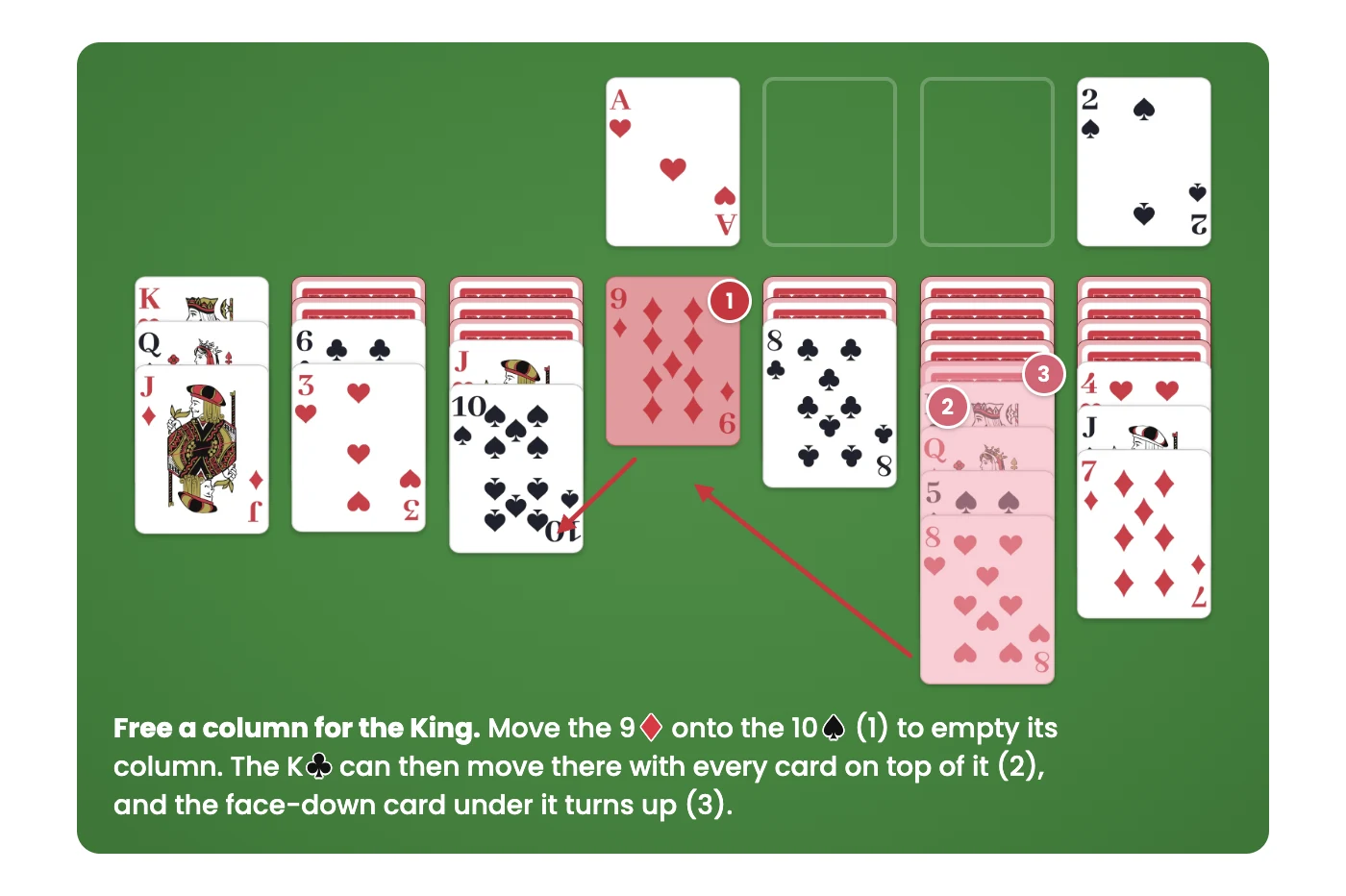
- Free a column for the King. A King sitting on face-down cards can only move to an empty column. Clearing a column gives it somewhere to go and turns up the card underneath.
- Check which cards come along. Moving a card also moves every card on top of it, in order or not. Before you move, make sure those extra cards won’t cover a card you want to build on next.
- Look a few moves ahead. Before you move, play out the next two or three moves in your head. A move that looks helpful can leave the next card with nowhere to go, while an optimal one can set up a chain that turns up a face-down card. Moving a card between two matching cards, like the 7♥ from the 8♠ to the 8♣, only helps if it frees the card it was sitting on.
- Don’t rush cards to the foundations. A card on a foundation can no longer hold the next-lower cards of the other color. For example, keep the 5♥ in the tableau while the 4♠ or 4♣ still needs a place to go.
- Choose your King carefully. When more than one King could take an empty column, pick the one whose move uncovers a face-down card or frees the cards you need next.
Your score rewards efficient play, so winning faster and in fewer moves scores higher. Every card or group you move, including moves to the foundations, and every Undo or Hint counts as a move. Undo, Hint, and moving a card off a foundation also count as penalties. Learn more about how Solitaire is scored.
Create a free account to save your stats, then deal a new game and see how your score compares on the leaderboard.