
Play Crescent Solitaire Online for Free
Crescent Solitaire is a two-deck game where 16 piles are placed in a crescent shape around eight foundation piles. You build four foundations up from the Aces and four down from the Kings, rearranging cards in each pile without knowing the ones beneath. Limited information and building in both directions makes this a challenging game.
Crescent Solitaire Objective
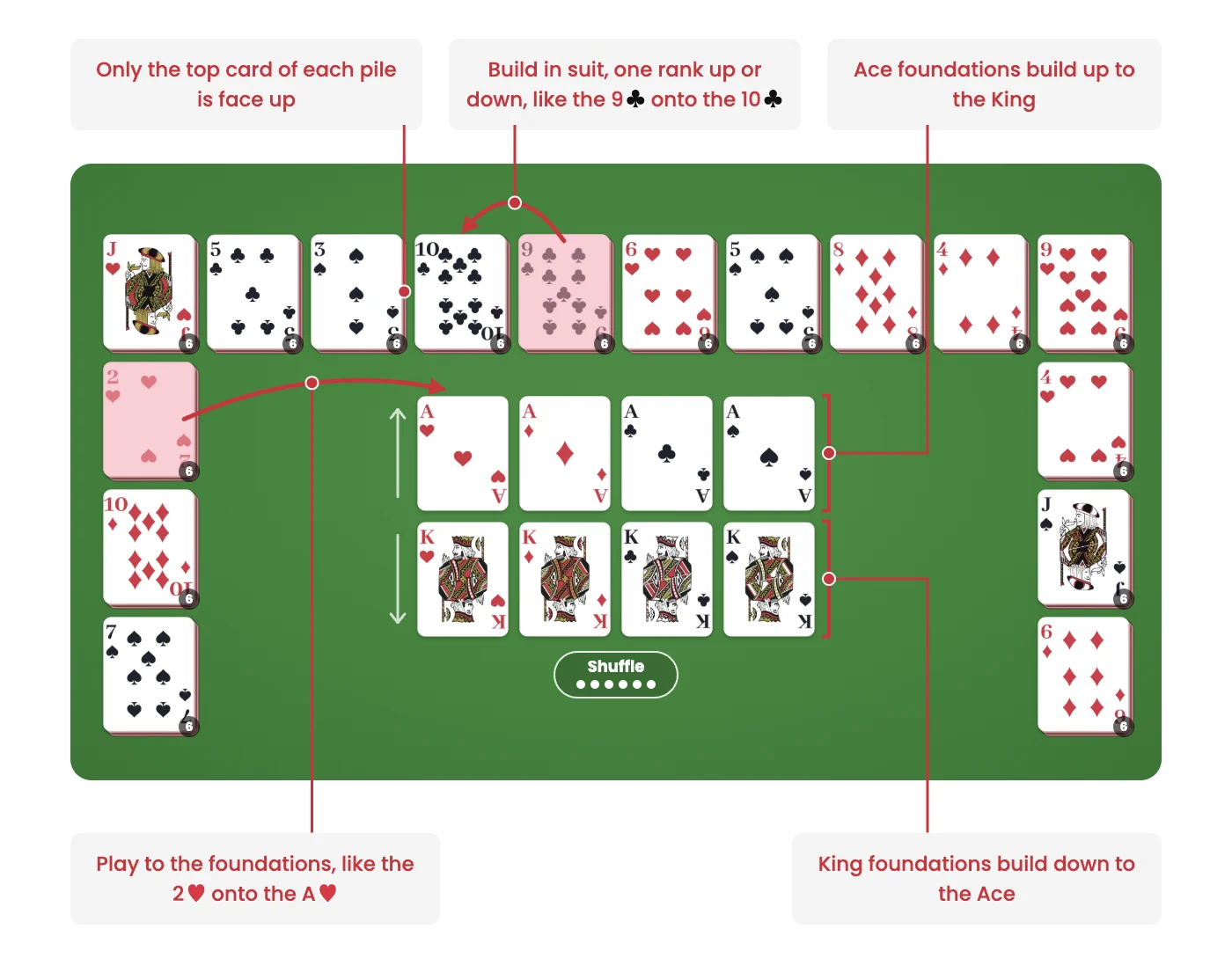
Win Crescent Solitaire by moving all 104 cards into the eight foundation piles. Each suit has two foundations, one that starts with an Ace and builds up to the King, and one that starts with a King and builds down to the Ace.
The other 96 cards are dealt into 16 piles of six, with only the top card of each pile face up. The piles wrap around the foundations in a crescent, or horseshoe, which is where the game gets its name. The cards underneath stay hidden until you uncover them, making strategic planning difficult. Every deal is one our computer player has won while seeing only the top cards, just as you do.
Crescent Solitaire Rules
- Play cards to the foundations, ascending from the Aces and descending from the Kings. An Ace foundation takes the next card up, so the 2♠ goes on the A♠. A King foundation takes the next card down, so the Q♥ goes on the K♥.
- Only the top card of a pile moves. Cards move one at a time, never in groups.
- Build on the piles in suit, up or down. A top card can go on another pile’s top card of the same suit that is one rank higher or lower, such as the 7♣ on the 8♣ or on the 6♣. You can build both ways on the same pile, and an Ace and a King can wrap.
- Uncover cards as you go. When you move a pile’s top card, the card under it is revealed.
- Empty piles stay empty. Once a pile is cleared, nothing can be moved into its space.
- Shuffle when you’re stuck. You get six shuffles a game, and you can switch to nine for an easier game or three for the classic challenge.
How Shuffles Work
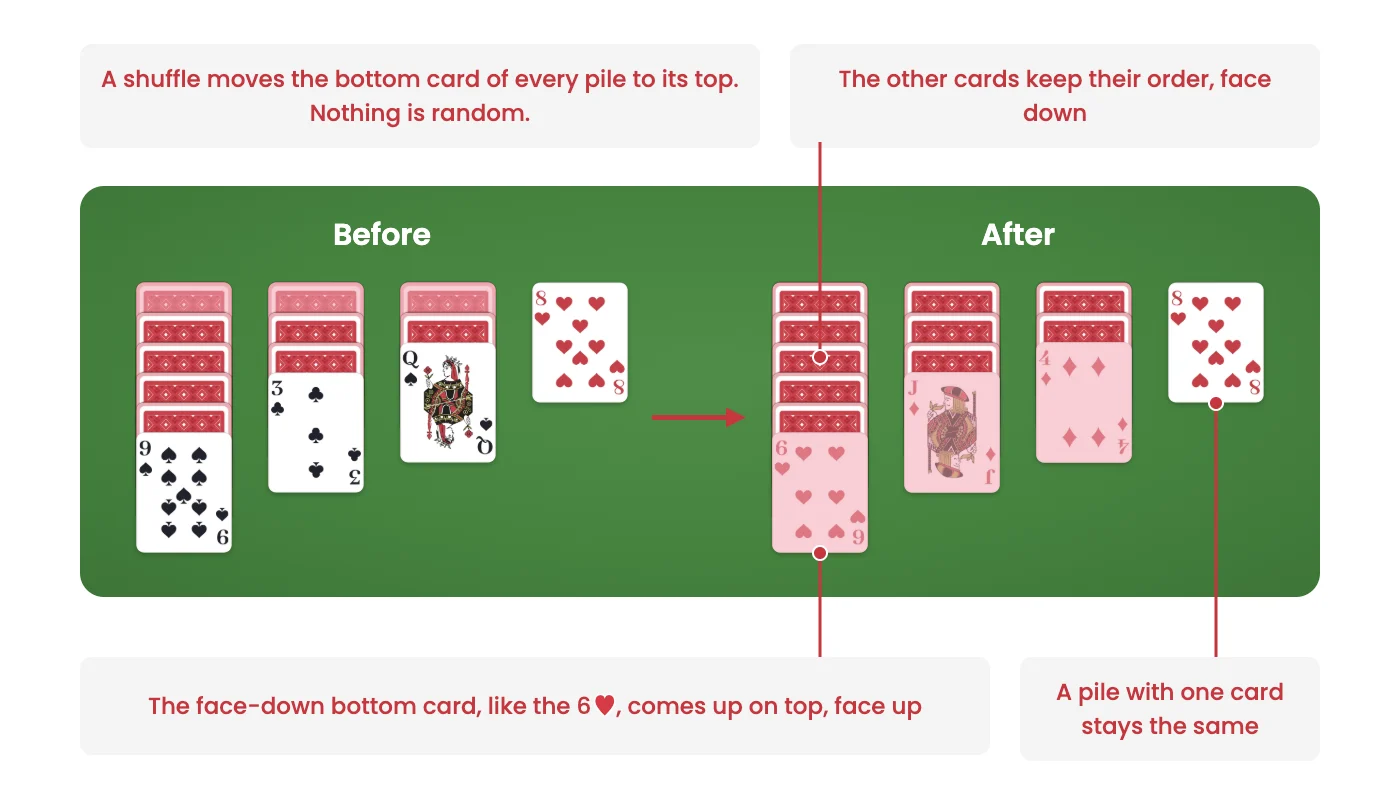
A shuffle moves the bottom card of every pile to the top of that pile, face up. The other cards keep their order, and piles with one card don’t change. Most bottom cards are still face down, so a shuffle usually shows you cards you haven’t seen yet.
The button shows how many shuffles you have left. You can shuffle at any time, not only when you’re out of moves, and each shuffle counts as a penalty.
Every game starts with six shuffles (Medium). For an easier game choose nine shuffles (Easy), or choose three (Classic) for the traditional challenge. Change it in Options > Settings > Game Options. The new setting starts with your next game, and each setting has its own deals and leaderboard.
The number on each pile shows how many cards it holds.
Moving Cards Between the Foundation and Tableau
Every suit has two copies of each rank, one for each foundation. The Ace foundation of a suit needs 2, 3, 4, and so on up to the King, while the King foundation needs Q, J, 10, and so on down to the Ace. Most of the time the two foundations want different cards, so a suit is often working from both ends at once.
When the top cards of a suit’s two foundations are next to each other in rank, the top card can cross from one to the other. If the Ace foundation ends on the 6♦ and the King foundation ends on the 7♦, the 7♦ can move onto the Ace foundation, or the 6♦ onto the King foundation. Crossing over isn’t a penalty, and it can open a spot for a card you’re holding.
You can also move the top card of a foundation back onto a pile, as long as it fits there. The starting Aces and Kings never move. Moving a card back to a pile counts as a penalty.
Tips and Strategies to Win Crescent Solitaire
- Check every top card. With eight foundations, up to eight cards are useful at any time. Look across all 16 piles before you make a move.
- Uncover cards on taller piles. Moving a card off a pile with cards under it turns up something new. Moving a pile’s last card only leaves a gap.
- Don’t bury the cards you need. Before you build on a pile, check that its top card isn’t one a foundation will want soon.
- Build each pile in one direction. Building a pile up and then back down can lock the cards you need underneath. Plan on building some piles up and others down so it’s easier to free the cards you need.
- Make every useful move before you shuffle. A shuffle changes the top card of almost every pile, so play out what you can first and keep track of the cards you’ve covered.
- Clear piles only when it helps. An empty pile can’t be used again, so a long pile in suit order can be more useful than a gap.
Create a free account to save your stats, then deal a new game and see how your score compares on the leaderboard.